According to an article from Xinhua News on 27 December 2007, China’s textile industrial output for 2007 is forecast to reach RMB 3.05 trillion (US$416.8 billion), a 21.9% increase year-on-year according to a report released by the China Textile Industry Association(1).
The annual industrial output of the textile industry in the PRC has experienced steady growth from approximately RMB 1.28 trillion in 2003 to approximately RMB 2.50 trillion in 2006, as illustrated by the following chart:–PRC urban household’s income and expenditure on cloth Annual per capita disposal income of PRC urban households between 2000 and 2006 has grown significantly (as illustrated in the following figure) and it can be expected to have contributed to lifestyle upgrades and demand for better quality apparels by consumers, in generalWith increasing Chinese citizens’ disposable income, China urban household’s expenditure on cloth has also been increasing from 2002 to 2006 as shown in the following chart:–
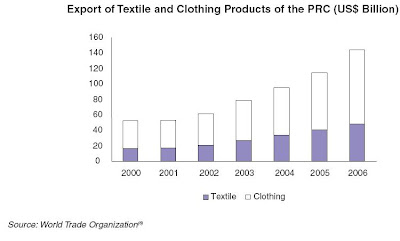
Exports of textile and apparel products of PRC Coupled with the further liberalisation of textile trade after the expiration of Multi-Fiber Arrangement (“MFA”) that was phased out over the period of 10 years (January 1, 1995 -January 1, 2005), the PRC is set to benefit from the expected increased international demand for textile and apparels following the PRC’s entry into the WTO. The total export of textile out of the PRC reached US$56.0 billion, an increase of US$8.0 billion when compared to the same period in 2006 of US$48.0 billion; the total export of clothing products out of the PRC reached US$115.0 billion, an increase of US$19.9 billion when compared to the same period in 2006 of US$95.1 billion(5). The following chart shows the increasing trend in export of PRC textile and clothing products over theperiod from 2000 to 2006:–
The PRC government initiatives to promote textile and apparel industry To strengthen the overall competitiveness of the textile and apparel industry, the PRC government issueda new five-year plan namely “The Textile Industry Eleventh Five-Year Plan ”(7) in June 2006 as guidance for the continued growth and development of the textile and apparel industry. Textile and apparel manufacturers are encouraged to further consolidate their competitiveness through technology upgrade and organic as well as inorganic growth to take advantage of the opportunities associated with the opening up of the PRC market. In addition, competent domestic manufacturers are also encouraged to develop a stronger brand identity. Production of high technology, functional and environmentally friendly textile and apparel products is encouraged to increase the production value of the industry.
Yarns Yarns are strands of fibres which have been spun and are used for the weaving of fabrics. They can be produced from natural fibres, chemical fibres or a combination of both. Thus, yarns are the basic raw materials in the production chain for the manufacturing of textile products. Each type of yarn has its own qualities and they are often blended to take advantage of the best properties of each material. As yarns are the basic raw materials used for weaving, the composition of yarns used determines the basic texture and characteristics of the fabrics to be produced.
Cotton Yarns Cotton yarns are made from 100% cotton. It is one of the most widely used materials in the textile and garment industry due to its various favourable properties:- absorbency : cotton provides high level of comfort as it can draw moisture from surrounding air creating a softer texture heat retaining : cotton fibres contain air pockets to form an insulating layer heat resistance : cotton can withstand heat of up to 110 degree celsius and is thus durable, and dyeing and washing friendly alkali resistance : cotton has a relatively high resistance against alkali allowing cotton fabrics to undergo various dyeing, printing and postweaving treatments necessary for the making of different cotton based products harmless to human body : cotton is totally natural and is harmless to human body Combed cotton yarns are extra-soft cotton yarns and are regarded as one of the cleanest and most uniform cotton yarns. To produce combed cotton yarns, cotton is subject to a carding and combing process by which, short fibres and unwanted materials are thoroughly removed, leaving clean and lustrous fibres for spinning. The result produces high-quality yarns with excellent strength and softness. Cotton yarns are used to produce an array of textile materials, such as apparel, towels, pillow cases and blankets.
Chemical Yarns Chemical fibres can be categorised according to their source of raw materials, namely man-made or synthetic sources
Man-made fibres are derived from cellulose materials from natural sources, such as wood, bamboo, aloe vera or soya bean, and are subjected to chemical and mechanical processing. Examples of man-made fibres include viscose , rayon and acetate . Synthetic fibres are derived from petrochemical products; examples of synthetic fibres include nylon , polyester , spandex and acrylic . Unlike natural fibres, the properties, composition and structure of chemical fibres are usually customised through various artificial processes to achieve desired characteristics, such as tensile strength, elasticity and absorbency.
Chemical fibres are believed to be more durable and easier to maintain. In particular, synthetic fibres, derived from non-cellulose materials, could be produced in bulk with relatively ease as they do not require an extensive area for cultivation and processing. The applications of different types of chemical fibres vary depending on their respective characteristics. For example, polyester, being known for its durability, and spandex, being known for its elasticity, are widely used in sports apparel. Due to its versatility, chemical fibres are often added with new elements to achieve specific functions, such as antibacterial function, to become functional fibres. Chemical fibres are widely used in sports apparel, functional outfits, such as bullet-proof and heat-resistant clothing, and umbrellas.
Loom-state Fabrics Loom-state fabrics are plain fabrics, woven from yarns, without any further treatment that alters or enhances the properties of the fabrics woven. Thus, the production of loom-state fabrics is considered as the second step following yarn production in the production chain for textile products. Loom-state fabrics are usually subjected to further processing, such as chemical treatment, dyeing, printing and finishing, before being transformed into consumer products.
The Manufacturing Process Above
Manufacturing of Yarns Inspection of raw materials Upon receipt of raw materials, mainly cotton, the quality testing centre will examine the quality of the cotton, including its colour, tensile strength, fibre length, purity and texture. The cotton will then be categorized for the production of different grades of yarns according to orders received.
Carding and combining Cotton from several bales is mixed and blended together to provide a uniform blend of fibre properties.The blended cotton is then transferred to cleaning and combing machines which separate and align the fibres into a thin web while removing majority of trash and unwanted materials. Upon completing the quality test, the web of cotton fibres will then be combined to form a rope-like form called “sliver” which will then be subject to further combing.
Combing Combing is an extensive cleaning process necessary for the production of combed yarns. The comber is a complicated machine composed of grooved feed rolls and a cylinder that is partially covered with needles to comb out short fibres and foreign materials thoroughly.
Spinning During the spinning process, combed cotton fibres are combined, drawn, blended, twisted, stretched repeatedly until they are spun into yarns with the desired thickness or “count”. The yarns can be stretched several times their original length and twisted many times per inch. The continuous stretching and twisting allows the yarns to achieve its essential textile properties, such as tensile strength, resilience and softness.
Winding and inspection This stage involves winding yarns into reels through the use of automated winding machines. When the desired length of a cotton yarn is reached, the cotton yarn will be cut automatically. Packaging and delivery of yarns Upon satisfactory visual inspection, the finished products will be packaged according to orders for delivery.
Manufacturing of Fabrics Warp formation The yarns will be placed on a beam in a parallel direction to form the warp.
Sizing To facilitate the interlacing of the warp and weft during the weaving process, a chemical solution, known as size, will be applied on the warp yarns to increase its strength and smoothness.
Shedding Strands of warp yarns will be placed through a combination of eye holes attached on the frame of a loom, known as the heddle frame. The arrangement of these yarns through the heddle frame determines the weave patterns, dimension and thickness of the finished fabrics.
Weaving During the weaving process, selected warp yarns will be lifted, according to the pattern directed by the heddle frame, to form a space through which the weft yarns can be inserted. The interlacing of the warp and weft yarns weaves fabrics according to a specified pattern.
Inspection The loom-state fabrics will be visually inspected by our quality assurance staff before sending for packaging. Minor defects will be identified and rectified accordingly.
Packaging and delivery of fabrics Upon satisfactory inspection, finished products will be packed and delivered to customers.
 PRC urban household’s income and expenditure on cloth
 With increasing Chinese citizens’ disposable income, China urban household’s expenditure on cloth has also been increasing from 2002 to 2006 as shown in the following chart:–
 Exports of textile and apparel products of PRC
 The PRC government initiatives to promote textile and apparel industry


